



Hair loss is a problem that can manifest as early as the teenage years or early adulthood. For men, it represents a significant burden, both aesthetically and emotionally. A hair transplant can be a suitable method for restoring hair in a young man, although it should not always be performed immediately. Correctly identifying the cause of the hair loss, assessing the progression of the condition, and undergoing a thorough medical evaluation are crucial steps.
Why is rushing at a young age a mistake?
Deciding to undergo a hair transplant too soon can make it difficult to achieve a natural-looking result in the future. In cases of androgenetic alopecia, transplanted follicles may continue to grow, while the surrounding natural hair continues to thin. Consequently, after a few years, a disproportionate hairline may develop, requiring further treatment or an additional procedure.
This issue is particularly significant in cases of rapidly progressing androgenetic alopecia at a young age. For men experiencing early hair loss, it is much more difficult to predict the extent of balding over the coming years or decades. Therefore, the physician should assess not only the current thinning or receding hairline but also the potential trajectory of further hair loss.
It is also important to consider the limited number of grafts. The follicles harvested from the donor area are a resource that must be managed with the future in mind; if this area is utilized too aggressively at the start of treatment, we may rule out the possibility of undergoing further procedures later on.
The role of pharmacotherapy prior to the procedure
For young men, a transplant is not always the best solution; instead, the priority is often to stabilize the hair loss process. If androgenetic alopecia is diagnosed, pharmacological treatment may be considered. Its aim is to curb further hair loss and preserve existing hair.
In this case, preparations containing finasteride or minoxidil, for example, may be used, although they will not be suitable for everyone. Therefore, the final decision regarding a specific treatment should be made by a doctor following a thorough assessment of the patient’s health and potential contraindications.
Before a potential hair transplant, the doctor may recommend:
- appropriately tailored pharmacotherapy,
- monitoring the rate of hair loss,
- trichoscopic assessment of the scalp and hair,
- monitoring of treatment outcomes,
- re-evaluation for transplantation after the situation has stabilized.
Pharmacological treatment will not restore hair in every case where permanent loss has already occurred. However, it can help preserve the hair that remains, which is crucial for the long-term outcome of the treatment.
When does a doctor deem a young patient suitable for FUE?
It is difficult to establish a specific age at which the procedure can automatically be performed. However, doctors exercise particular caution with young men, as the progression of hair loss can be difficult to predict in such cases.
Eligibility for a transplant should be determined by the overall clinical picture, not merely by age. Therefore, the physician primarily takes into account:
- the onset of balding and the patient’s age,
- stability and rate of hair loss,
- hair density and quality in the donor area,
- stage of hair loss,
- projected supply of available grafts,
- condition of the scalp,
- familial pattern of hair loss,
- the patient’s expectations,
- treatment to date and its results.
Assessing the donor area is of great importance. It is from this area that follicular units are harvested during the procedure. Therefore, before the procedure is performed, it is necessary to determine how many grafts can be used without causing excessive thinning of the area.
When should you get a hair transplant?
The decision of when to undergo a hair transplant is based on a variety of factors, not just age. It is crucial to determine whether the hair loss has stabilized so that a natural-looking result can be planned with the future in mind.
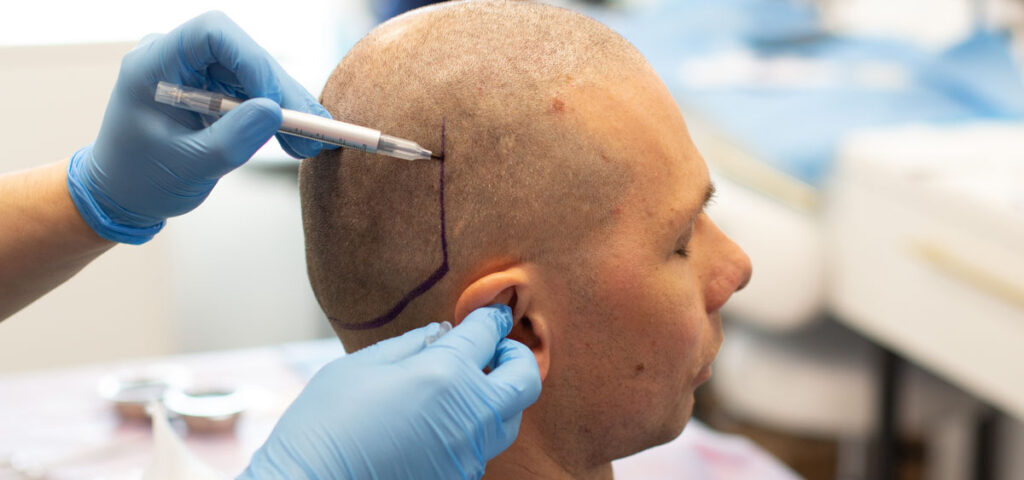
For young patients, maintaining the right proportions between the new hairline and existing hair is crucial. It is not always necessary to lower the frontal hairline to the maximum extent; a conservative approach to its placement—while reserving some grafts for future use—is often the most sensible solution.
A good candidate for the procedure is a person who:
- the cause of the hair loss was identified,
- hair loss is adequately stabilized,
- the donor area has good characteristics,
- there is a sufficient supply of grafts,
- expectations regarding the results are realistic,
- The patient understands the possibility of progressive hair loss.
The final decision regarding whether to perform a hair transplant always rests with the physician conducting the assessment. If factors are present that increase the risk of an unsatisfactory outcome, it may be far more prudent to postpone the procedure or continue monitoring the situation.
What does the qualification process for FUE involve?
Qualification for a hair transplant involves a consultation and an assessment of the scalp, hair, and donor area. The doctor conducts a detailed analysis of the rate of hair loss and discusses previous treatments and family history of balding, performing a microscopic examination if necessary. Based on this, the feasibility of the procedure is assessed, and its scope is planned.
Why does the FUE method require proper planning?
This method involves harvesting individual follicular units from a donor area and subsequently implanting them into areas requiring restoration. Economical use of grafts is particularly important for young patients to preserve the option of further treatment should hair loss progress.
Hair transplant for a young man – strategy is key
It is worth remembering that a hair transplant for a young man should always be preceded by a thorough diagnosis and an assessment of the prospects for further hair loss. If the hair loss process is active, the doctor may first recommend stabilizing it.
Once stabilization has been achieved, the donor area is in good condition, and expectations are realistic, the FUE procedure can become part of a long-term hair restoration plan.
