


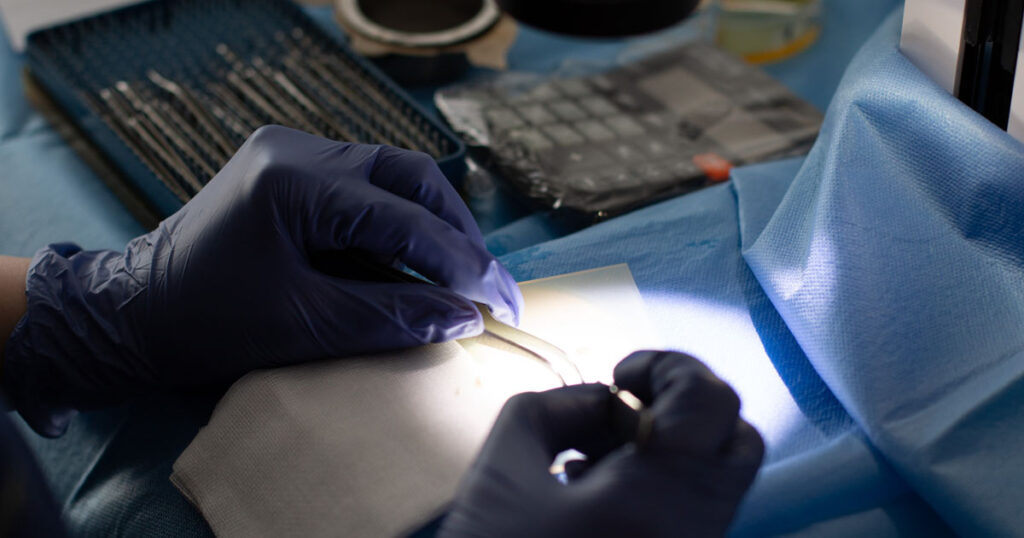
The number of grafts available for transplantation is limited by the capacity of the donor area. In cases of extensive hair loss or following previous procedures, there may be insufficient hair on the scalp to cover all the areas requiring restoration. In such situations, the doctor may also consider using hair from outside the scalp. Find out what BHT entails and what role this technique plays in transplant planning in our article!
Why is the donor area so important?
The primary source of grafts for transplantation is the hair located at the back and sides of the head. It is from this area that individual follicular units are most commonly harvested using the FUE method.
However, this does not mean that an unlimited number of hairs can be harvested. The donor area is a finite resource that must be managed carefully. Excessive extraction can lead to visible thinning in this area; therefore, transplant planning must also take into account future hair loss.
A more challenging situation arises in cases of extensive hair loss, where the area requiring restoration is too large relative to the number of available grafts. Limitations may also apply to individuals who have previously undergone a hair transplant.
BHT – an additional source of hair follicles
BHT (Body Hair Transplant) is a technique that involves using hair from parts of the body other than the scalp. Grafts are harvested individually—much like in the FUE method—and can then be used to replenish hair on the scalp.
Donor material can be obtained from areas such as the beard, chest, or other hairy parts of the body. However, not all areas are equally suitable. Therefore, BHT should be viewed as an additional option for specific situations rather than a substitute for standard graft harvesting from the scalp.
Beard hair – when can it be used?
The beard is one of the areas that can serve as an additional source of grafts. Hair from this region is typically thicker than scalp hair, a factor that may be significant when planning its placement. Furthermore, one should not assume that, once transplanted, it will behave exactly like hair from the scalp.

The distinctive characteristics of hair from different areas of the body remain evident even after implantation. Consequently, the physician can plan to use it in specific locations or combine it with grafts harvested from the scalp. In practice, what matters most is not only the quantity of available hair but also its quality and suitability for the specific transplant plan.
Can body hair be combined with hair from the head?
This approach is considered when the donor area is limited. Grafts from the scalp and other parts of the body can be used within a single transplantation plan.
However, this approach requires taking into account differences in hair structure. Beard or chest hair may have a different structure and growth cycle than scalp hair. Therefore, not all grafts should be treated as identical material.
When planning the procedure, the doctor takes into account, among other factors, the target area, hair characteristics, and the way specific types of grafts can be distributed.
What does the qualification process for BHT look like?
The first stage is a thorough assessment of the donor area. The doctor determines how many follicular units can be harvested from the scalp and then evaluates potential additional sites for obtaining grafts.
Factors such as hair density, thickness, structure, and growth pattern are significant. The surface area requiring restoration and the number of grafts needed to execute the planned procedure are also taken into account.
Such an assessment makes it possible to determine whether BHT is indeed applicable. In some cases, it may be more appropriate to reduce the scope of the transplant or to perform subsequent procedures in stages.
What are the limitations of a BHT transplant?
BHT does not solve all the problems associated with an insufficient donor area. Above all, there must be a sufficient amount of body hair—outside the scalp—with characteristics suitable for use in transplantation.
It is also important to consider the differences between hair from various parts of the body. Consequently, achieving a natural-looking result requires careful planning of graft placement. Prudent management of the available donor material is also essential; simply increasing the number of harvested units should not be the primary goal of the transplant.
Why does a specialist’s experience matter?
When the number of available grafts is limited, the planning of the entire procedure becomes particularly important. The physician must assess which areas require restoration first, how many units can be harvested, and whether the material obtained from different sites can be effectively utilized.
Therefore, when choosing a specialist, it is worth paying attention to their experience in hair surgery and the number of procedures performed. Piotr Turkowski, MD, PhD He has been performing hair transplants for 13 years and has over 1,000 procedures to his credit; he also co-authored the first Polish textbook on hair transplantation.
During a consultation regarding BHT, it is possible to discuss not only the option of using body hair but also the availability of scalp grafts, the planned number of units, and their placement.
BHT as an option for a limited donor area
A limited number of hairs available for extraction from the scalp does not always rule out the possibility of a transplant. In carefully selected cases, hair from other parts of the body can serve as an additional source of donor material. However, BHT is not a universal solution; a consultation and a thorough assessment of both the donor area and the area requiring restoration are necessary before making a decision.
The most important aspect is the proper planning of the available material. When the number of available grafts is limited, every single one counts; therefore, the extraction technique and subsequent placement should be part of a well-considered, personalized transplant plan.
