


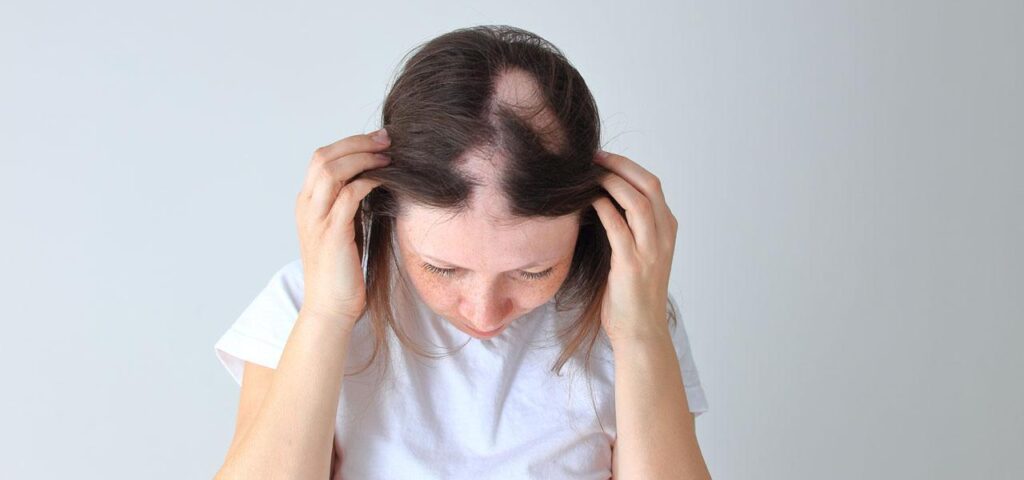
Alopecia areata (AA) is a chronic inflammatory disease of an immunological and autoimmune nature, characterized by damage to hair follicles and hair loss on the scalp, eyebrows, eyelashes, and other areas of the body. It accounts for approximately 2% of all dermatological conditions and affects about 0.1–0.2% of the population, occurring in both men and women. The condition can manifest at any stage of life, though initial symptoms frequently appear in childhood or adolescence. Given the autoimmune nature of the disorder, conventional hair transplantation is not a viable treatment option; instead, thorough, interdisciplinary diagnosis is the key to effective management.
What is alopecia areata and what is its course?
Alopecia areata is a dermatological condition characterized by the appearance of oval or round patches of hair loss. The lesions typically develop suddenly, and the skin at the site of hair loss remains smooth and unaltered, without scarring. At the margins of expanding patches, so-called “exclamation mark hairs”—short hair shaft fragments measuring a few millimeters—can often be observed. The course of the condition is highly unpredictable and recurrent; most patients experience at least one episode of the disease during their lifetime.
It is worth noting that this condition is frequently diagnosed even in the youngest patients; initial symptoms may appear during preschool or early school age, and in approximately 60 percent of cases, the disease manifests before the age of 20. In young children, hair loss may affect not only the scalp but also the eyebrows, eyelashes, and body hair. Immediate triggers in children can include sudden stress, intense emotional tension linked to a change in environment or the start of school (a new school or kindergarten), or infections; treatment approaches for children take into account the delicate nature of the young body and the need to provide psychological support.
It is worth noting that while this disease does not directly affect one’s general physical condition, it drastically impairs quality of life, leading to severe psychological stress and, in many cases, social isolation or depression.
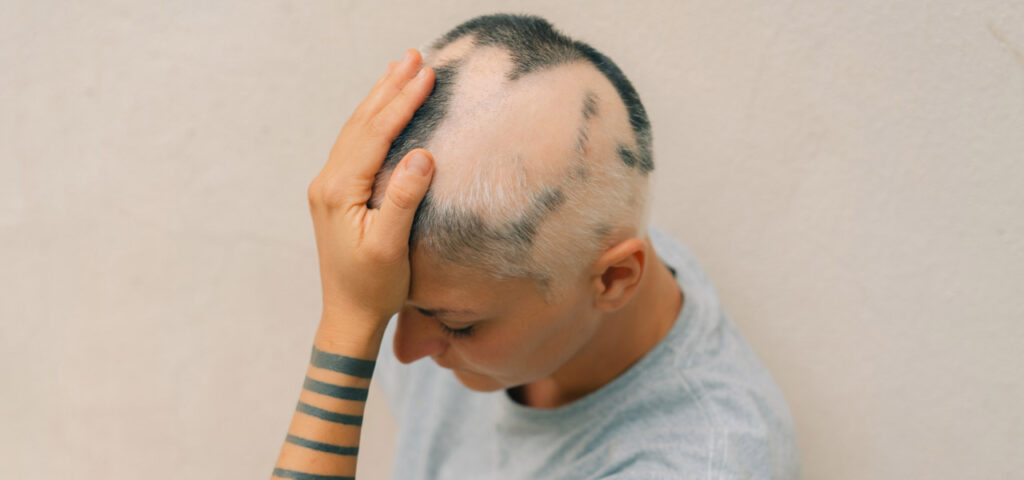
Types of alopecia areata
Based on the extent and location of the lesions, three main clinical variants are distinguished in medicine:
- Common alopecia areata (alopecia areata vulgaris – AAV): Presents as single or multiple round or oval patches that may coalesce. A specific variant is *ophiasis* (band-like alopecia), characterized by a band of hair loss in the occipital region extending to the temples and forehead.
- Alopecia areata totalis (AAT): Characterized by complete hair loss across the entire scalp.
- Alopecia areata universalis (AAU): The most severe form, characterized by the complete loss of hair on the scalp (including eyebrows and eyelashes) and on all other areas of the body.
In approximately 10–12% of patients with alopecia areata (more frequently in children than in adults), the disease process also affects the nail plates, causing pitting (thimble-like appearance), longitudinal ridging, splitting, or discoloration.
Main causes of alopecia areata
The pathogenesis of alopecia areata is complex and results from the interplay of several significant factors:
- Immunological and autoimmune factors: Hair loss is caused by an abnormal immune response involving the release of pro-inflammatory cytokines by epidermal cells and the formation of a dense inflammatory infiltrate around the hair follicle. The follicle shrinks and undergoes miniaturization, entering the catagen phase prematurely. The condition often co-occurs with other autoimmune disorders, such as autoimmune thyroid diseases (Hashimoto’s, Graves’ disease), vitiligo, lupus erythematosus, or lichen planus.
- Genetic factors: A familial occurrence of the condition is observed in approximately 10–20% of patients, confirming a hereditary basis.
- Psychosomatic factors and stress: Severe, chronic stress and traumatic life events (such as the death of a loved one, divorce, or job loss) very often precede the initial flare-up of the disease by triggering inflammatory mechanisms in the skin. This creates a vicious cycle, as hair loss exacerbates stress, which in turn intensifies the disease process.
Interdisciplinary approach: Dermatologist and surgeon in one place
At PT CLINIC, we recognize that hair loss lies at the intersection of two medical specialties. While a dermatologist understands the underlying condition and a surgeon understands the procedure, the patient should not have to shuttle between them, receiving conflicting opinions. Our key expert is Dr. Katarzyna Osipowicz—a distinguished dermatologist, venereologist, and trichologist. She holds a PhD from the Medical University of Warsaw and a habilitation degree based on research that includes the innovative use of hair transplants for scarring caused by lichen planus; she has also authored over fifty scientific publications. She honed her expertise under world-renowned authorities, including Prof. Rodney Sinclair in Melbourne, Prof. Dedee Murrell in Sydney, and Prof. Cristina Has in Freiburg.
While married in our private lives, professionally we jointly run a clinical center, upholding the highest scientific standards. Thanks to a broad team of specialists—including dermatologists, trichologists, an anesthesiology team, and epidemiologists—the entire process, from diagnostics to advanced treatment, takes place in a single location.
Innovative clinical trials for alopecia areata
Our clinic is not merely a medical practice but also an authorized clinical research center in Warsaw, listed in the official ClinicalTrials.gov registry maintained by the U.S. National Institutes of Health. We have successfully conducted dozens of Phase II and III clinical trials for global pharmaceutical companies, including Pfizer, AbbVie, Amgen, Sun Pharma, and Concert Pharmaceuticals.
Crucially, as many as six of the studies we are conducting focus directly on alopecia areata. We have participated in research on the latest medications—including groundbreaking JAK kinase inhibitors—capable of genuinely restoring hair growth for the first time. We also conduct advanced pediatric studies involving children as young as six; such programs are entrusted to only a handful of elite centers worldwide. This offers our patients a unique opportunity to access—free of charge—modern therapies that are not yet commercially available in Poland.
Specialized treatment for alopecia areata
The therapeutic process requires an early and targeted trichological diagnosis. Depending on the severity of the condition, we implement modern medical protocols at our center:
- Topical and systemic pharmacotherapy: use of steroid ointments, creams, and solutions, and, if necessary, targeted oral medications or cyclosporine A.
- Intralesional injections (Triamcinolone / Triamhexal): Precise administration of a steroid preparation directly into the lesions to suppress local inflammation.
- DCP (diphenylcyclopropenone) therapy: A highly effective method involving the induction of a controlled, mild allergic skin reaction using a safe chemical substance. The goal of the therapy is to redirect the body’s immune response and suppress the autoimmune attack destroying the hair follicles. Precise administration of a steroid preparation directly into the affected areas to resolve local inflammation.
- Phototherapy and physical therapy: PUVA and narrowband UVB therapy, which stimulate cellular renewal.
- Stimulating treatments: professional scalp mesotherapy, carboxytherapy, and targeted nutrient cocktails that promote regrowth.
Frequently Asked Questions (FAQ)
Bibliography and medical sources
- Ewa Joss-Wichman, Grażyna Broniarczyk-Dyła, Współczesne poglądy na etiopatogenezę łysienia plackowatego, Postępy Dermatologii i Alergologii XXII; 2005/4.
- Marta Kuty-Pachecka, Czynniki psychologiczne i psychopatologiczne w łysieniu plackowatym, Psychiatria Polska 2015; 49(5): 955–964.
- Katarzyna M. Chyl-Surdacka, Agnieszka Gerkowicz, Grażyna Chodorowska, Rola witaminy D w łysieniu plackowatym, Przegląd Dermatologiczny 2016, 103, 185-188.
- ClinicalTrials.gov – Rejestr badań klinicznych prowadzony przez National Institutes of Health (NIH), obejmujący dane na temat nowoczesnych terapii i badań klinicznych II oraz III fazy w obszarze łysienia plackowatego.
